
Freedom to Operate Is Leaving the Spreadsheet

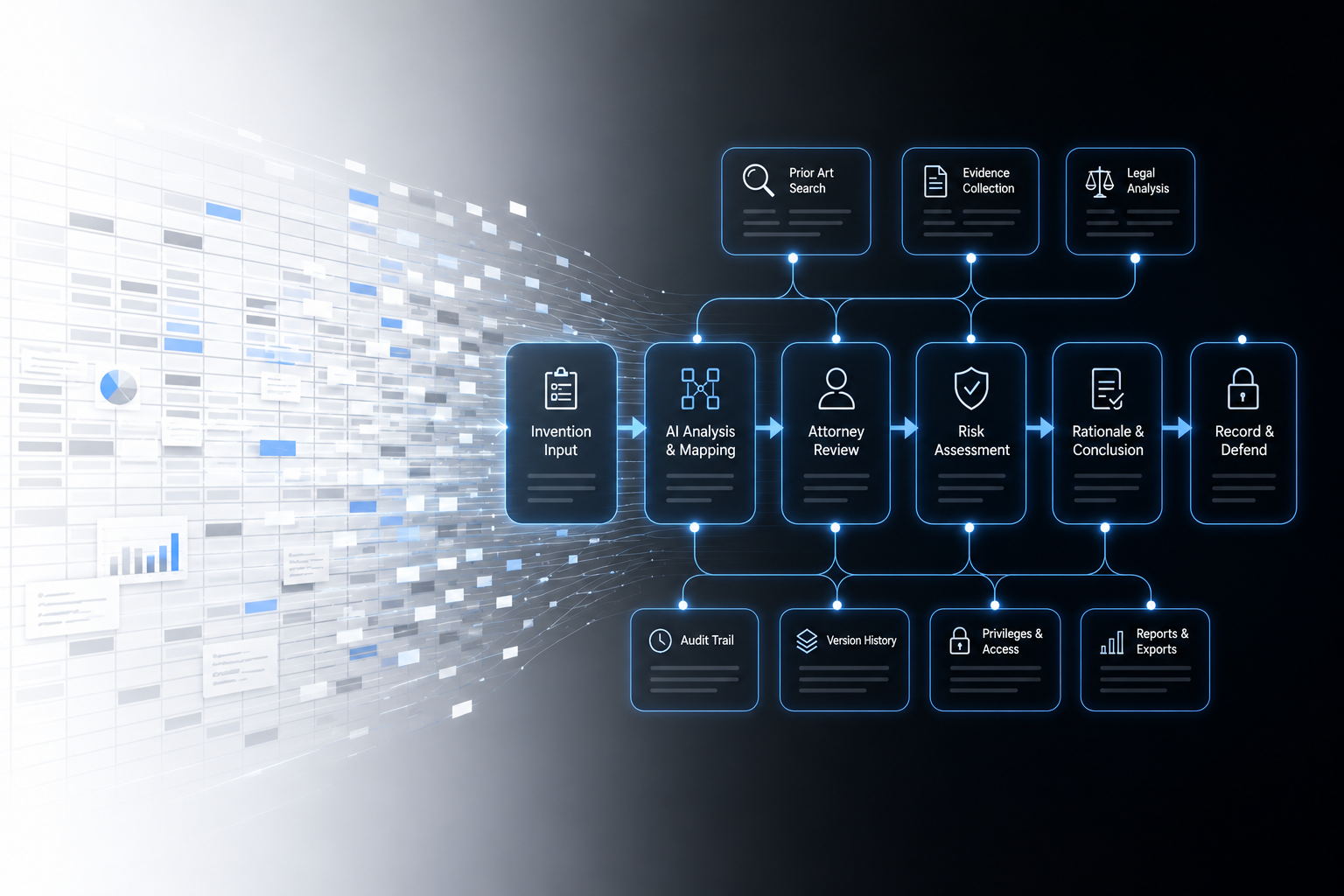
ClearstoneIP’s FirstPass puts AI inside the freedom-to-operate workflow itself, raising a larger question for legal departments: Can patent-clearance work become faster without losing the structure, privilege discipline and recordkeeping that make it defensible?
For innovative companies, freedom to operate is the patent question no one wants to learn about for the first time in litigation.
The question is simple enough: Can we make and sell this product without infringing someone else’s patent? The answer rarely is. It depends on product details, patent claims, prior analyses, technical facts, attorney judgment and a record of what the company knew and did along the way.
That is why FTO analysis sits in an uncomfortable place for many in-house legal teams. Everyone knows it matters. Fewer organizations have a disciplined, repeatable process for doing it. The work too often lives in spreadsheets, email threads, informal comments and the memory of one or two people who have been around long enough to remember why a decision was made.
Gabe Sukman, founder and CEO of ClearstoneIP, has spent the last decade trying to move that work into a more durable structure. A patent attorney with more than 25 years of experience, including time at the USPTO and in law firm practice, Sukman saw a tooling gap in an area that did not receive the same attention as patent prosecution management. Companies had tools for getting patents, he said in our interview, but when it came to freedom to operate—“the flip side of that,” focused on making sure products do not infringe third-party patents—“everybody’s using spreadsheets and it seems so outdated.”
ClearstoneIP built Clearstone FTO as a dedicated workflow platform for that work. On June 2, 2026, the company launched FirstPass™, an AI capability that is more specific than the now-familiar promise of a legal AI assistant. Clearstone describes FirstPass as workflow-native AI that operates inside Clearstone FTO and delivers structured analysis within the attorney review process, rather than generating outputs outside the environment where FTO decisions are documented.
That distinction is the story.
FTO Is a Risk Question, Not Just a Patent Search
Freedom to operate is not merely an exercise in finding patents. It is a risk-management process that asks whether a company can proceed with a product, feature or launch in light of third-party patent rights.
The stakes can be high. Federal patent law provides that, after a finding of infringement, a court may increase damages up to three times the amount found or assessed. That does not mean every patent dispute creates enhanced-damages exposure. It does mean the quality of the company’s investigation, decision-making and documentation can matter when later questions arise about what the company knew and how it responded.
Sukman framed the issue in practical terms: Companies need to surface problematic patents, analyze them thoroughly and maintain the record of that analysis in a way that is not scattered across emails, chats and spreadsheet versions.
That is a better way to understand Clearstone’s position in the market. The company is not simply selling patent review software. It is selling a system of record for a legal-risk process that often becomes difficult to reconstruct after the fact.
Why Spreadsheets Fall Short
Spreadsheets are familiar, flexible and cheap. They are also a weak long-term home for FTO work.
The problem is not only version control, though version control alone can become painful. The larger issue is that FTO analysis accumulates. Patent families evolve. Product versions change. Prior art and claim determinations may need to be reused. Outside counsel, in-house counsel, engineers, patent searchers and business stakeholders may all contribute to the same review. If that history is not captured in a structured way, the organization loses leverage every time a new product, new patent family or new attorney enters the picture.
Clearstone describes Clearstone FTO as a platform built to preserve claim determinations, prior art references and FTO decisions in a searchable knowledge base. Its product materials emphasize product-centric patent analysis, embedded FTO workflows, historical claim analysis, role-based access and AI-generated analysis delivered inside the review workflow.
The company’s public case-study materials show the kind of workflow burden it is targeting. Clearstone says Cytiva’s prior homegrown FTO tool created bottlenecks around collaboration, cross-referencing prior analyses and scaling with a growing product portfolio. Clearstone also says Braskem used the platform on a complex FTO project involving more than 15 patent searches, hundreds of claim determinations and thousands of patent families, with 100 attorney hours saved.
Those are company-published case studies, not independent benchmarks. But they illustrate the core issue clearly: FTO is not just a search problem. It is a workflow, memory and documentation problem.
What AI Integration Actually Means Here
When ClearstoneIP says it has integrated AI into FTO work, the claim is more useful than the phrase usually suggests.
Sukman was careful in the interview to distinguish FirstPass from a generic AI chat experience. The point, he said, is “not about kind of having a chat with AI and doing reports.” It is about stepping into the workflow and performing a first layer of analysis on the work users are already doing.
That matters for legal departments. A report generated outside the matter still has to be transferred, reviewed, reconciled and preserved. An AI output that lands inside the workflow can be evaluated in the same place attorneys are documenting claim determinations, rationale, status, escalation and review history.
Clearstone’s launch materials say FirstPass executes prior art analysis, claim determinations and risk assessment in the same environment where attorneys document rationale and manage decisions. Sukman put it more bluntly in the company’s announcement: “FTOs are not reports” and “AI lives in the workflow.”
The beta claims are notable, but should be framed carefully. Clearstone says FirstPass was made available to a select group of IP professionals during an early 2026 beta program; beta participants reported 50 percent reductions in FTO review time; and in live testing, FirstPass analyzed 50 patent documents in under two minutes while delivering structured claim-level analysis, risk ratings and workflow status suggestions. Clearstone also says comparative testing identified the same high-risk patents attorneys had manually flagged.
That is useful evidence. It is not the same thing as an independent validation study. The safer conclusion is that Clearstone has company-published beta results and practitioner feedback suggesting FirstPass can accelerate early review and help lawyers focus attention on patents that require deeper judgment.
Edward Evans, a partner at Michael Best & Friedrich LLP and a FirstPass beta participant, described the practical effect as giving attorneys a first impression of each patent before opening the file and shifting some time away from mechanical annotation toward higher-level legal analysis.
That is the right framing. FirstPass is not replacing the patent lawyer. It is trying to make the first layer of FTO review faster to begin, more structured and easier to escalate.
The Privilege Question Requires Discipline
The privilege issue deserves care.
Sukman said Clearstone is designed to support attorney-client privilege by assigning attorneys to FTO records and keeping the work inside a supervised legal environment. “Our position is that, as long as that’s happening, then it provides a good defensible position for maintaining attorney-client privilege for those records,” he said.
That is a meaningful workflow design choice. It is not a privilege guarantee.
Privilege depends on facts: who is communicating, why the communication is being made, who has access, whether counsel is actually supervising legal advice and whether the company later preserves or waives the protection. Software can support a privilege-aware process. It cannot create privilege merely by labeling a record.
This is where Clearstone’s positioning is most useful. The platform is less like a generic repository and more like a structured workspace for FTO activity. It can help legal departments control access, assign responsibility, preserve rationale and separate legal review from casual business chatter.
For general counsel, the right diligence question is not, “Does the platform make this privileged?” It is, “Does the workflow help us preserve the conditions privilege requires?”
The Data Questions Are Not Procurement Formalities
The same discipline applies to AI governance.
Sukman said in the interview that customer data is not used to train models and that customers own their data. He also referenced AWS hosting, SOC 2 Type II compliance, GDPR and security protocols. Those representations matter. They should also lead to the next layer of questions.
Which model provider or providers power FirstPass? Does customer product information, claim text, prior art or attorney commentary travel to a third-party model API? Are no-training commitments contractual? What retention terms apply? Can customers configure where data is processed? How are AI outputs logged, corrected and preserved?
Clearstone’s public privacy policy is dated September 8, 2022, and says it applies solely to information collected by the company’s website. It does not, by itself, answer current AI product-data routing questions for FirstPass. That does not mean the product lacks appropriate protections. It means enterprise buyers should ask for current AI, security and data-processing documentation before deployment.
For legal departments handling sensitive product roadmaps and potentially privileged patent-risk analysis, those are not boilerplate procurement questions. They are deployment requirements.
Connecting FTO to Enterprise AI
Clearstone is also moving toward broader enterprise AI integration.
Sukman said the company now has an MCP connector that can allow organizations to pull Clearstone data into enterprise AI environments and push information from other sources back into Clearstone so it becomes part of the FTO record.
That direction is worth watching, but it should not be oversold. The technical details of Clearstone’s connector—including authentication, permissions, what data is exposed, what users can write back and how those actions are logged—were not available in the materials reviewed. For enterprise legal teams, those details matter as much as the existence of the connector itself.
The strategic point is clear enough: Clearstone is not just trying to make an FTO platform smarter. It is trying to make FTO data usable inside the broader AI environments where legal and business teams increasingly expect to work.
What Comes Next
Sukman also previewed a forthcoming agentic capability inside Clearstone FTO. He described a system equipped with tools to read patent data, look up prosecution history at the USPTO and suggest next steps inside the platform. No release date or product name was announced in the interview, so this should be treated as a roadmap, not as a currently available feature.
Still, it points to where this market is going. The legal AI conversation is shifting from isolated answers to governed systems that can retrieve information, use tools, suggest actions and preserve a record of what happened. In FTO, that evolution is especially consequential because the work is both technical and legal, and because the record may matter years later.
Who Benefits
The most obvious users are sophisticated patent teams doing FTO work at volume. But the more interesting market may be companies that know they should be doing more patent-clearance work and have not had the resources, infrastructure or internal expertise to stand up a mature process.
Sukman described a familiar failure mode: A company has an internal “FTO guru” who knows the product, the patents and the history; that person leaves, and the organization is left with a vacuum. FirstPass is aimed at that gap. It gives experienced patent teams a head start and gives less mature teams a more structured place to begin.
That does not make FTO casual. It makes it more visible.
For legal professionals evaluating tools in this space, ClearstoneIP is worth a close look, particularly for teams conducting FTO work at volume or organizations trying to formalize a process that has been too dependent on spreadsheets and institutional memory. The governance questions—model providers, data routing, contractual no-training commitments, privilege controls and attorney-review logs—should be confirmed before deployment.
But the core proposition is strong: FTO is moving out of spreadsheets and into governed workflow.
That is the real significance of FirstPass. It is not just AI for patent review. It is AI entering the place where patent-risk analysis, attorney supervision, institutional memory and defensible recordkeeping already need to live.
Freedom to operate is leaving the spreadsheet. The question for legal departments is whether the next place it lives will be structured enough to trust.
Originally published in Corporate Counsel Business Journal
Freedom to Operate, Artificial Intelligence, Clearstone FTO, FirstPass, Patent Analysis
Subscribe to get new Clearstone FTO Articles


